Monday, April 9, 2007

Texas Connections at JazzFest

Austin-based blogger Beth Swindle will be covering the New Orleans Heritage & Jazz Festival for Festival Preview. In this post, she previews two JazzFest performers with Texas roots.

According to the pre-festival schedule, a number of Texans (and some folks we've adopted) will make appearances at the New Orleans Jazz Heritage Festival, including two terrific lady piano players with styles as vast as the Texas plains. If you're not yet acquainted with her A-Town (a.k.a. Austin) sound, check out boogie woogie maven Marcia Ball. She plays at 2:10 pm Sunday 29 April at the Acura Stage, just ahead of the godfather of the genre, Jerry Lee Lewis. Her hysterical lyrics and jumpin' keyboards more than offset Marcia's no-frills vocals.

If sultry siren is more your style, a headliner Saturday 28 April is 2004 Record of the Year winner Norah Jones(Gentilly Stage 5:30pm). Though now based in NYC, Norah grew up in Dallas and attended the prestigious music school at the University of North Texas. Jones' delicate demeanor and breathy tone pull you in for a intimate listening experience and a great contrast to the other performers in her timeslot: Ludacris and Rod Stewart. Together these ladies are sure to represent fine specimens of Texas entertainment.

Friday, April 6, 2007

Monterey gears up to celebrate the big 5-0

Staking its claim for the honors of the music festival event of the 2007 season, the Monterey Jazz Festival announced an expansive program to celebrate its 50th anniversary this September.

Besides a stellar lineup of jazz legends, the program features three musicians in special rolls, a grounds expansion including a new historical exhibit and performance venue, publication of a coffee table history book, and launch of a new record label.

The world-renowned event takes place September 21-23, 2007, on the familiar oak-studded grounds of the Monterey (CA) Fairgrounds, the location of the festival since 1958. Tickets went on sale last week at the festival website and by phone at (925) 275-9255.

Headline artists include Diana Krall, Sonny Rollins, Ornette Coleman, the Dave Brubeck Quartet featuring guitarist Jim Hall, John McLaughlin and the 4th Dimension, the Gerald Wilson Orchestra, Los Lobos, bluesmen Otis Taylor and James Hunter, Cuban vocalist Issac Delgado and the supergroup of Dave Holland, Gonzalo Rubalcaba, Chris Potter and Eric Harland.

Three musicians will be featured in special roles and play in multiple configurations. Artist-In-Residence, Trumpeter Terence Blanchard, this year's artist in residence, will appear with the MJF Chamber Orchestra, his own quintet, the Next Generation Jazz Orchestra, and a group of festival all-stars. Legendary jazz guitarist Jim Hall will be the "showcase artist" and will appear with his own quartet, in duo with pianist Geoff Keezer, and with Dave Brubeck's Quartet. Commission artist Gerald Wilson will premiere "Monterey Moods," his third milestone composition for MJF.

The grounds additions are meant to mark the anniversary and establish a future legacy. A new strolling lane adjacent to the main stage entrance and named for festival founder Jimmy Lyons will feature displays about the festival's history and an autograph booth. At the end of the lane, a new lounge will serve as a venue for DJs spinning jazz, hip-hop and dance music.

A new book, "The Art of Jazz," recapping the 50-year history of the festival will be available for sale on the website before the festival. The new record label, Monterey Jazz Festival Records, will issue historic and new festival recordings.

Friday, March 23, 2007

Riffing in the cathedral

From FP contributing blogger Bill Rehm. Thanks, Bill.

Jazz guitarist Bill Frisell helped get the 8th annual SF Jazz Spring Season off to a soaring start in his Friday night concert in Grace Cathedral atop of Russian Hill in downtown San Francisco. The festival, which takes place in nine different settings over a three month period, is known for its eclectic line-up, unusual concert venues, and wide-ranging jazz performances.

Audience members were advised in advance that there would be a seven-second delay in sound reverberation within the cathedral, and as Frisell walked out into the cavernous cathedral with its vaulted ceilings and an audience sitting on all four sides of the small center stage, he raised his eyes 200 feet upward and whispered, "This is far out."

Frisell said few other words during the 105-minute concert, letting his solo guitar performance to do all the talking. His distinctive sound showed an expansive range of styles, tone, and artistry — with long meandering riffs that had some of us remembering Jerry Garcia riffs from decades gone by. These longer improvisational meanderings were intermixed with a shorter acoustic stylings of songs from Bob Dylan and Tony Bennett.

It was one of the most unusual and memorable concerts I've ever attended, with Bill Frisell's acoustic guitar and Grace Cathedral's acoustic sound teaming up to leave us mesmerized, tantalized, and wanting more.

SF Jazz continues in April with upcoming concerts by Dianne Reeves, Anoushka Shankar, Ben Riley Monk Legacy Band, Freddie Cole and the Dave Brubeck Quartet.

Wednesday, March 14, 2007

For 50th anniversary, Monterey to honor favorite son Dave Brubeck

Dave Brubeck was there at the beginning, and he'll be the guest of honor this fall as The Monterey Jazz Festival holds the 50th edition of its groundbreaking event.

To kick off the publicity for the Sept. 21-23 event, festival organization will host a Golden Gala Celebration April 7, 2007 at the Tehama Golf Club in Carmel, California. The mayor of Monterey, Chuck Della Salla, has proclaimed that the week of April 8, 2007 will be Dave Brubeck week. Proceeds from the gala will go to support the festival's youth education program.

“Dave Brubeck is one of the reasons that the Monterey Jazz Festival exists,” said MJF General Manager Tim Jackson. “In 1958, Dave’s participation in getting us established and his performance at the first Festival is well-documented. Here we are, 50 years later, and his music still epitomizes the sound of jazz to the world. He is literally one of the icons of the art form. I think [MJF Founder] Jimmy Lyons would be extremely happy and proud to see that Dave is still composing and recording at age 86—and performing to packed houses.” Jackson added, “This award acknowledges the gratitude that the Festival and jazz fans from around the world feel for a man who has transcended the boundaries of what we expect a musician to be.”

Brubeck’s use of polytonality and odd meters set him apart from the rest of the “West Coast Cool” scene, and has been a hallmark of his style since the beginning of his career. One of the most popular albums in jazz was Brubeck’s “Time Out” released in 1960, featuring the iconic songs “Blue Rondo A La Turk” and “Take Five,” one of the most recognized instrumental songs of the 20th century. Jimmy Lyons, as a DJ in San Francisco, became an early champion of Brubeck, regularly playing Dave’s music on his radio show on KNBC. Lyons then booked Dave into Oakland’s Burma Lounge in 1949, Dave’s first influential gig. Brubeck played the first--and last--Monterey Jazz Festivals that Jimmy Lyons booked in 1958 and 1992.

Brubeck has been a longtime favorite at Monterey. 2007 will mark the 14th appearance at the festival for the 86-year-old pianist.

At the gala event, he will receive the festival's first MJF Legends Award. Entertainment at the event will be provided by the Jamie Davis Group, featuring the Bay Area vocalist who also sings with the Count Basie Orchestra. Tickets for the gala are $250. Visit the MJF website for more information.

Monday, February 12, 2007

Monterey Jazz features artist-in-residence Terence Blanchard

The Monterey Jazz Festival, a leader in jazz education since 1958, announced that MJF's 2007 Artist-In-Residence, Terence Blanchard, will play a special concert with his Quintet at the historic Golden State Theatre in Downtown Monterey on Thursday, March 22 at 8:00 PM.

Tickets go on sale on February 20th and are available through the MJF website, www.montereyjazzfestival.org or by calling the MJF Ticket Office at 925-275-9255. Tickets are priced at $30 for General Admission, $45 for Premium General Admission and $75 for Gold Circle Admission, which includes an after-concert reception with the Grammy Award winning artist.

The concert kicks off the 3rd Annual Next Generation Festival, which is sponsored by MJF. The weekend-long event is an expansion of the Monterey Jazz Festival’s Annual National High School Jazz Competition, now in its 37th year. Featuring more than forty groups from across the nation, the top big bands, combos and vocal ensembles will win cash awards and an invitation to perform at the 50th Annual Monterey Jazz Festival presented by Verizon, September 21-23, 2007. Auditions will also be held for chairs in the Monterey Jazz Festival’s Next Generation Jazz Orchestra, which tours internationally and is a featured ensemble on the Festival's Sunday afternoon Arena/Lyons Stage.

Blanchard was named as the 2007 MJF Artist-In-Residence last fall, and has been a committed supporter of jazz education throughout his career. Terence was one of the fire-tempered “Young Lions” of the early 80s, and has been on the cutting edge of the resurgence of hard-bop and other modern jazz styles for his entire adult life. As one of his generation’s most artistically mature and innovative artists, Blanchard will be thoroughly engaged with the Monterey community in 2007. He will perform with his own group on the stage of the newly renovated and historic Golden State Theatre, act as a judge during the MJF's 37th Annual National High School Jazz Competition, mentor students at the MJF Summer Jazz Camp and perform at the Monterey Jazz Festival presented by Verizon, September 21-23, 2007.

"We are very excited to feature Terence this year as our Artist-In-Residence,” says Tim Jackson, MJF’s General Manager and Artistic Director. “His artistry, breadth of experience and ability to communicate will make this a residency worth remembering for our community and for our young students. We are also pleased to present our first concert at the beautiful Golden State Theatre in downtown Monterey and hope that this will be the first of many MJF musical moments at this historic facility."

Featured in Terence’s band will be some of the most talented new stars on the jazz scene: Brice Winston on saxophone; Fabian Almazan on piano; Derrick Hodge on bass and Kendrick Scott on drums. Winston’s work includes membership in Terence’s regular band, and he is a featured musician and soloist on numerous soundtracks by Terence as well. Fabian Almazan, a Cuban native and recent graduate from the Manhattan School of Music, is poised to be one of the leading pianists of his generation. Derrick Hodge and Kendrick Scott are both members of Terence’s Flow group, have contributed to Blanchard’s recent soundtracks, and have gigged or recorded with Donald Byrd, Dianne Reeves, Pat Metheny, Mulgrew Miller, Kanye West, Mos Def, David Sanborn, and many others.

The Golden State Theatre is located at 417 Alvarado Street in downtown Monterey, California, and has been recently restored to its stately and opulent 1926 glory, with beautiful frescos, gilded details and stained glass lighting.

Wednesday, January 31, 2007

FP comments on The Festival Network

The plans of the newly formed Festival Network to create a large portfolio of "best of breed" festivals that takes advantage of economies of scale marks a important milestone in the development of the music festival industry.

It also raises a possible cause for concern that a business that has been largely characterized by small operators motivated by their love of the music could be moving in the direction of corporate management that is in it for the money.

I don't think that's the case with The Festival Network. My interviews this week with CEO Chris Shields and George Wein, chairman of the company's Festival Productions division, revealed an seemingly sincere concern for preserving the joys of the festival-going experience (see related posts).

Shields spoke convincingly of his intention to keep commercial sponsorship to an "appropriate" level. For example, he said that new events produced by the company would be less likely to be named for a corporate sponsor, moving in the opposite direction from several of the company's existing events that are named for a Japanese electronics manufacturer and an all-American purveyor of deep-fried dough.

While some festival attendees might prefer an entirely corporate-free zone at their favorite events, I'm not in that camp. The income generated by corporate sponsorship is a major factor in improving the quality of production and keeping ticket prices affordable. Those are things that all festival-goers should appreciate.

On the other hand, I've definitely seen festivals that go too far in allowing the intrusion of corporate marketing to affect the culture of the festival. If we want to see commercial logos festooning every part of an event, we'd go to NASCAR.

And while there is good reason to hope that The Festival Network will tread lightly as it applies increased business discipline to the festival management business, it may help to open the door for other companies who would have fewer scruples about exploiting the community to make a buck.

Thankfully, mom and pop festivals run purely for the love of presenting great music to an appreciative audience are always going to be with us. But it seems inevitable that big companies producing multiple festivals is a trend that is going to accelerate, and especially at the highest profile events.

We'll keep an eye on this issue in the festival seasons ahead and continue advocating for an ethic of festival management where the commerce serves the art and not the other way around.

George Wein reflects on 50 years in the festival business

As George Wein, the father of the modern music festival, moves on to a new chapter in his storied career, he paused to reflect on his accomplishments in an interview with Festival Preview.

Wein said he started off as a jazz pianist in college playing with future jazzmen Max Kaminsky and Pee Wee Russell, and moved to the business side of the business as a young man. "I realized I had a better head for being a promoter than a producer, so I started a club, and then I had a chance to do a festival.

"I didn't know anything about festivals at the time. Other than county fairs, there was nothing like it at the time. I knew one thing--that i wanted to hear as much jazz as i could all the time."

He said he wanted to duplicate the experience of jazz listening one could get by wandering all night from club to club on 52nd Street in New York. "That's what I tried to do when I put Newport together for the first time, and all these years later, that is still what I am doing."

As festivals became established and proliferated, they began to have an important impact on tourism, on raising awareness for the music, and creating work for musicians. They also have had a great influence on music education, he said.

"I don't like to claim credit for [the impacts of festivals] except it all went on in relationship to what we were doing. On the other hand, these things would have happened anyway. If I hadn't created a festival, someone else would have. It is just that I happened to have the opportunity to do it the first time."

Jazz festivals were also a huge hit in Europe in the '50s and '60s. Wein recalled bringing jazz tours to Europe featuring greats like Duke Ellington, Miles Davis, Thelonious Monk, Ornette Coleman and Sarah Vaughan. "We would go from London to Amsterdam to Brussels to Copenhagen to Stockholm to Berlin, literally holding a festival in every major city in Europe. Those were incredible days," he said.

Wein's 2003 autobiography Myself Among Othersrecounts his many memories from his long career.
"I wrote the book to catalog some of these things and make them a part of the history, but it's what you are doing now that counts. And I hope to still be doing things for the next few years," he said.

Looking ahead
At 81, Wein has visions of expanding the business, creating new festivals and opening new markets. But he recognized that at his stage of life, he needed a partner with deep pockets.

He was impressed with the sincerity and vision of Chris Shields and Shoreline Media. "These people have money, they are very respectful of my legacy, and they want the legacy to grow. Also, I'm proud enough to feel that they need me and I can help them."

So he is looking forward to new challenges. "Absolutely, there is room for the company to grow. There are areas that need festivals and there are festival concepts that can be created.

"I have been a very blessed person, even surviving all the bad days I've had--and I had a lot. I had riots and I was in debt. As I said in the book, I have never been poor but I've been broke."

After concluding the deal for the sale of his company, that's one experience he probably won't have again.

The Festival Network sets course to open new markets

The new company that emerged from the acquisition by Shoreline Media of George Wein's Festival Productions Inc. intends to launch new festivals in the U.S. and overseas and is also on the lookout for existing festivals to acquire.

"The goal is to unite many best-of-breed festivals under one corporate whole," said Chris Shields, CEO of The Festival Network, in an interview with Festival Preview. "The key factor that we look for is a unique location. Sophisticated programming and the entire festival experience follows from that," he said.

Shields said that Wein began the "festival era" in 1954 with the first Newport Jazz Festival. "By locating the festival in a unique location, Newport, he had something intangible in the name even before he brought in the terrific music."

Festival Productions currently produces a sizable list of major festivals, including the JVC Jazz Festivals, New Orleans Jazz & Heritage Festival, Essence Festival, and Newport Folk Festival, among others. Under the deal, these will continue to be managed as a division within the new company, headed by Wein and including his existing management team.

In a separate interview (see related item), Wein told Festival Preview that he is impressed with the sincerity and vision of Chris Shields and Shoreline Media. "These people have money, they are very respectful of my legacy, and they want the legacy to grow," he said.

Shields said that loyal patrons of Festival Productions events will see very few changes. "There will be a subtle enhancement of the overall production aesthetic and feel." Besides improving the live experience, such attention to sound, lighting, and stage production will be reflected in the quality of content that is offered for sale in the festival "aftermarket," he added.

Shoreline Media was formed in 2004 by Shields and Joseph Stanislaw, formerly the founder and chief executive of Cambridge Energy Research.

Shields, 36, studied jazz theory at Berklee and began his career as a musician. He has been involved in the festival production for 10 years, including a brief stint working for Wein at Festival Productions and later running his own Nectarfest in Nantucket and Martha's Vineyard and directing Bell Atlantic Jazz Festivals in Boston, New York, Philadelphia and Washington.

Shoreline Media has produced musical events for the Olympic Games, and will do so for future Olympics at least until 2012. The Olympics deal is an indicator of the company's interest in tie-ins to sporting events and other entertainment forms. Shields said that the company's main focus would be on music festivals, but noted that sports programming captures more than 60 percent of overall sponsorship dollars.

Combining many festivals under one banner provides economies of scale in production, purchasing and programming and bring advantages in appealing to sponsors, Shields said. The audience for high-end festivals is an attractive demographic for advertisers, especially during a vacation experience when they are looking for new experiences, he added.

Finding a balance
However, the company is especially sensitive to the danger of over-commercializing festivals, "which are really all about the personal experience," Shields said. He said the aim is to keep a delicate balance of "helping corporate brands be appropriately affiliated" without letting branding run amok.

While Festival Productions sold naming rights to some of its events, such as the Dunkin' Donuts Newport Folk Festival, Shields said that new festivals the company would launch "are more likely to emphasize the location of the event in their names."

While giving nothing away as to possible new events, Shields said "there are locations in the U.S. that should have festivals and don't." He also said the company would be active in international markets. As for domestic acquisitions, he said "there are very few we would consider acquiring, but there are some. Talks with several of them have already begun, and we expect to have announcements to make in the coming months."

Such deals might take the form of an acquisition with the existing ownership retained for managing the event. In rare cases, the company might seek to affiliate with an events that don't fit the company's business model, because of their non-profit status, for example.

While Shields is most focused on resort destinations, he says the location model can apply to city festivals as well, especially by finding unusual locations for the concerts. Also, while While Festival Productions' greatest strength has been in jazz, Shields said all kinds of "sophisticated music" would be offered, especially "mergings of different styles. We really appreciate where artists are stretching their limits and playing into other genres."

The Festival Network deal come together in a series of discussions between Shields and Wein beginning in the spring of 2006. As the year went along and Wein became more comfortable that the company would respect his legacy, the talks intensified and were concluded in early January.

Shields said that he is thrilled to be working with Wein again. "George is the man who brought music out of the smoky clubs to these beautiful locations. if you look at the great festivals that have lasted thorught the ages, almost all of them follow the example of George Wein and Newport. We are excited to be his partner, to grow with him and learn from him."

Thursday, December 21, 2006

Mike Stern: The Tom Cruise Of Jazz?


Some of you may be puzzled that I would make the assertion that the sensei of jazz fusion known as Mike Stern should be compared to the borderline psychotic who decides to revisit his childhood memories of recess on daytime talk shows. However, Mike Stern exhibited the same automatic smile that we see Tom Cruise exhibit in every interview he does and every picture that is taken of him (at least when he is prepared for it) during the first installment of his doubleheader at Yoshi’s Jazz And Sushi on Wednesday (the 20th of December), where Stern seemed overloaded with endorphins from the moment he arrived at the club to the end of his performance.

I first sighted Stern as he walked in the front door of Yoshi’s, about 45 minutes prior to taking the stage, and started setting up a table from which to sell and autograph his new album, Who Let The Cats Out?. It didn’t seem like Stern felt he was at work, as he beamed his way through interactions with far more than a handful of fans before he played his first note.

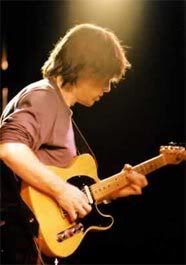
After that first note eminated from his Telecaster, the guitarist, along with master drummer Dennis Chambers, bassist/scat singer Richard Bona and saxophonist Bob Franceschini, simply practiced his way through a masterful hour-and-a-half set. I say practiced because it didn’t seem like a show to the guitarist and his band; it seemed like they might as well have been jamming in Stern’s bedroom, but this claim is misleading, as most bedroom jam sessions do not produce an ohm of the transcendental electricity that filled Yoshi’s concert hall during this genre-hopping band’s set. With a keen and efficient use of a delay effect in his rig, Stern, along with his spotless band, went through bebop, pop fusion, funk, and rock with such a fluidity that what he was really playing was pure enjoyable musical sound, with all hints of constraint regarding style and genre gone happily AWOL.

This was showcased best during Stern’s solo spot, which came about two-thirds of the way through the set and seemed to sum up whatever it really is that is the eclectic philosophy that takes hold of Stern when he straps on a guitar- melodies, rhythms, and genres changed throughout the eight-minute guitar aria, but his seemingly bulletproof anticipation and limitless imagination made these changes not annoying, but welcome updates and improvements on something that did not need updates or improvements anyway. Dennis Chambers exhibited this same dichotomy of playfulness and genius during his solo spots, and unlike most drummers he was able to keep the moments in which Yoshi’s concert hall was filled with just the sound of his skins attached to the greater purpose- the song- and was able to put out what sounded like powerful extended fills rather than a really loud interruption, a defect of most drum solos that are played within and as part of a modern music context.

But the most impressive thing about Stern and his band during the time I observed them at Yoshi’s was that it seemed like they were not aware of their respective jobs at hand- they played their set, beaming like Tom Cruise on the Today Show all the way through, and played like professionals without alluding one bit to the fact that what they were doing was a profession.

Tuesday, December 12, 2006

Eddie Palmieri: Latin Warrior And His Band Protect The Honor Of Yoshi's


In a small concert hall that allows its patrons to eat sushi from the adjacent restaurant while watching performers, Yoshi’s Jazz and Sushi would seem to the average out-of-towner to be a novelty joint that would not offer topnotch performers of the jazz world on a nightly basis. However, Yoshi’s has established itself as arguably the best jazz venue in the whole Bay Area, and Eddie Palmieri and his band, La Perfecta Dos (the “sequel” to his original 1960’s-era band, La Perfecta) more than maintained that reputation on Sunday (December 10th).

Palmieri and his band are major frequenters of jazz festivals worldwide, and I expect to see him on multiple festival stages later this year, though this show was an excellent preview for later festival outings.

There were two shows that night, and I went to see the 9 p.m. show, as tickets to the 7 p.m. show were already sold out. The 200-plus crowd, at least half of whom joined me in the around-the-block line outside the club that was mercifully warmed on this Arctic night by overhead heaters, came to the show ready to dance and would turn the middle aisle of the concert hall into a packed-to-the-gills dance floor by the halfway mark of Palmieri’s set. Of course, to anyone who knows Palmieri’s energetic brand of salsa, mambo, and Latin jazz, this is usually something to be expected. Palmieri, the band leader, pianist, and back-up vocalist, and his band- Herman Olivera on lead vocals, Giovanni Hidalgo on congas, Eddie Zervigon on flute, Jimmy Bosch and Joe Fielder on trombone, Eddie Resto on bass, Anthony Carillo on bongos, Jose Claussell on timbales, and John Santos on Coro- delivered flawless, high-energy grooves in every song, while sometimes taking off in polyrhythms and varying meters in the middle of the song, and sporadically starting off higher-energy numbers with a ballad-like piano prelude, all just to keep everything fresh.

The icing on the cake, however, was how much the musicians were visibly involved in and enthusiastic towards the music they were creating- the entirety of the set showcased every single musician with an ear-to-ear grin on his face, except at the grimace-filled times when they were straining to get out that last line of notes or beats on time with the most power possible. The only time this passion ever detracted from the overall vibe of the concert, in my mind, was when Hidalgo took an extended conga solo, which left the percussionist to play by himself in the middle of the last song of the set; while it was in its own right incredible, the solo seemed out of place in a set of songs driven by the collective effort of 10 musicians.

Unfortunately, neither band leader Palmieri or lead vocalist Olivera formally introduced any of their songs in the set, so I, who was not and still am not particularly familiar with Palmieri’s material, was not able to discern the definite names of any songs played during Palmieri’s show. However, from the words of the mantras that were repeated by Olivera throughout the duration of some of the songs, I was able to make an educated guess that the names of the four songs that really showcased Palmieri and his band’s explosive power were “Echando ‘pa Lante”, “Con La Perfecta”, “Allegria”, and “Lengua Su Cante”. In both “Allegria” and “Echando ‘pa Lante”, the bongo solos performed by Carillo were able to lock into the groove while still rocketing into the stratosphere with their machine-gun tempo, while Olivera constantly engaged the crowd with his charisma and dancing and Bosch and Fielder flailed back and forth like two human Slinkies while shooting fireball harmonies out of their trombones. Meanwhile, “Con La Perfecta” and “Lengua Su Cante” were of the more low-key variety, yet the songs still maintained the power of the faster numbers through the virtuoso chromatic playfulness of Palmieri during his piano solos and polyrhythms from the bongos, congas, and timbales that charged the groove of the songs and kept them from becoming the least bit tiresome.

Shortly after “Lengua Su Cante” (the last song of the set) had concluded and the band walked off the stage, the Yoshi’s MC announced that Eddie had left the building. It was a slight disappointment for the 100-strong contingent of fans clamoring for an encore, but the explosive show put on by Palmieri proved that Yoshi’s is still more than making good on its promise to deliver great music, along with great raw fish.